Lavinia
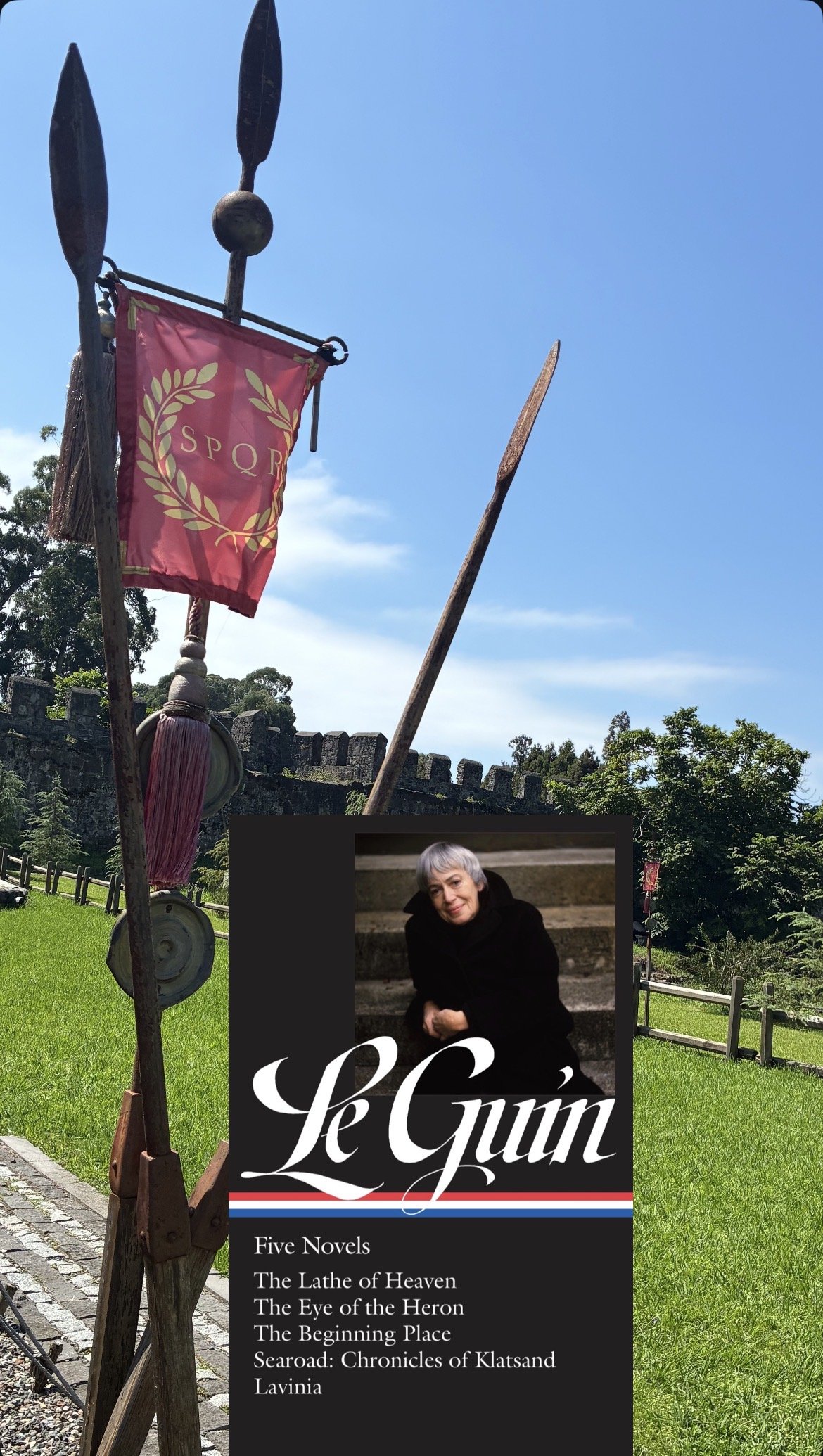
Wow, Ursula Le Guin can seriously write classical women. Known as the iconic woman of sci-fi, Le Guin is perhaps less well known for some of her novels that sit outside that genre. In Lavinia (2008), Le Guin gives Aeneas’s last wife, Lavinia of Latium a voice. Through Le Guin’s prose, Lavinia comes to life, a dynamic and pious woman of ancient Bronze Age Italy. In wildly clever ways Le Guin plays with Vergil’s Aeneid* bringing classical Italy to life for modern readers. One doesn’t need to reach the afterword of this novel to understand Le Guin’s deep reverence for Vergil’s poetry; Lavinia is an ode to the great Roman poet that develops the relatively undeveloped character of Lavinia in the Aeneid.
As I travel through regions once conquered and ruled by the long hand of the Roman Empire, I have thoroughly enjoyed reading Le Guin’s take on what life might have been life for an early Latin queen. Lavinia the novel is heart-wrenching and beautiful. Lavinia the woman is complex and accepts the fate the gods (and the poet) assign her.
Lavinia opens with a map titled “Latium meum” (in English: my Latium); yes, this is a self-conscious, first-person narrative, as told by Lavinia. Next follows lines from Vergil’s Aeneid, in both the original Latin and in English translation: “A single daughter, now ripe for a man, now of full marriageable age, kept the great household. Many from broad Latium and all Ausonia came wooing her . . .” For those who are not familiar with Vergil’s famous epic, the Aeneid, it is interesting to note that while Lavinia becomes Aeneas’s last wife on the shores of Italy, she is silent in the poem. Thus, Le Guin’s novel provides Lavinia her long-deserved voice. What’s more, Le Guin’s Lavinia is metacognitive of her role as immortalized by The Poet (as many refer to Vergil), lending Lavinia elements of both modernism and fantasy. The novel follows her life as a maiden before Aeneas and the vanquished Trojans sail up her river. It follows through war and peace, marriage and motherhood, into old age and beyond. Always, Lavinia connects with daily ceremony and ritual, with the oracles and omens of her time. This is a novel that bends time and narratives, but Le Guin’s writing makes it feel perfectly natural for its setting and character. In a sense, Lavinia may be read as a mythological fantasy, but I find it closer to a historical fiction based on The Poet’s great epic (an elaborate and lyrical fan fiction of sorts).
Whatever its genre, Lavinia is a beautiful novel. It brings the domestic and ritual worlds of early Italy alive through the memory and voice of Lavinia, daughter of King Latinus and Queen Amata of Latium. What’s more, this novel is a great next read for anyone who has been captivated by the current cultural attention given to classical epics thanks to the success of Christopher Nolan’s The Odyssey (which, I might add, also borrows from Vergil’s Aeneid). Whether you find yourself wandering through Old World haunts of classical heroes (like me), or just want to fall into the annals of antiquity with clever prose that expand upon epic traditions of old, Lavinia is a book well worth reading.
* A note on spelling: the author of the famous Latin poem, the Aeneid, is Publius Vergilius Maro, or Vergil. In the Middle Ages, the spelling transformed to become Virgil by Christian scribes (affiliating it with words like virgos and vir (virgin and man). Hence, Dante Alighieri’s The Divine Comedy (1321) names Virgil (with an “i”) as his guide. In other words, Vergil or Virgil are now considered acceptable spellings of The Poet’s name. Le Guin, opts for Vergil, which appears closer to his Latin name.
Bibliography:
Le Guin, Ursula. Five Novels: The Lathe of Heaven, The Eye of the Heron, The Beginning of Place, Searoad: Chronicles of Klatsand, and Lavinia. Editor Brian Attebury. Library of America E-Book Classics, 2024. Libby edition.
A Few Great Passages:
“I am a fleck of light on the surface of the sea, a glint of light from the evening star. I live in awe. If I never lived at all, yet I am a silent wing on the wind, a bodiless voice in the forest of Albunea. I speak, but all I can say is: Go, go on” (1726-1727).
“Men call women faithless, changeable, and though they say it in jealousy of their own ever-threatened sexual honor, there is some truth in it. We can change our life, our being; no matter what our will is, we are changed. As the moon changes yet is one, so we are virgin, wife, mother, grandmother. For all their restlessness, men are who they are; once they put on the man's toga they will not change again; so they make a virtue of that rigidity and resist whatever might soften it and set them free” (1969).
“I think if you have lost a great happiness and try to recall it, you are only asking for sorrow, but if you do not try to dwell on the happiness, sometimes you find it dwelling in your heart and body, silent but sustaining” (1972).