The Correspondent
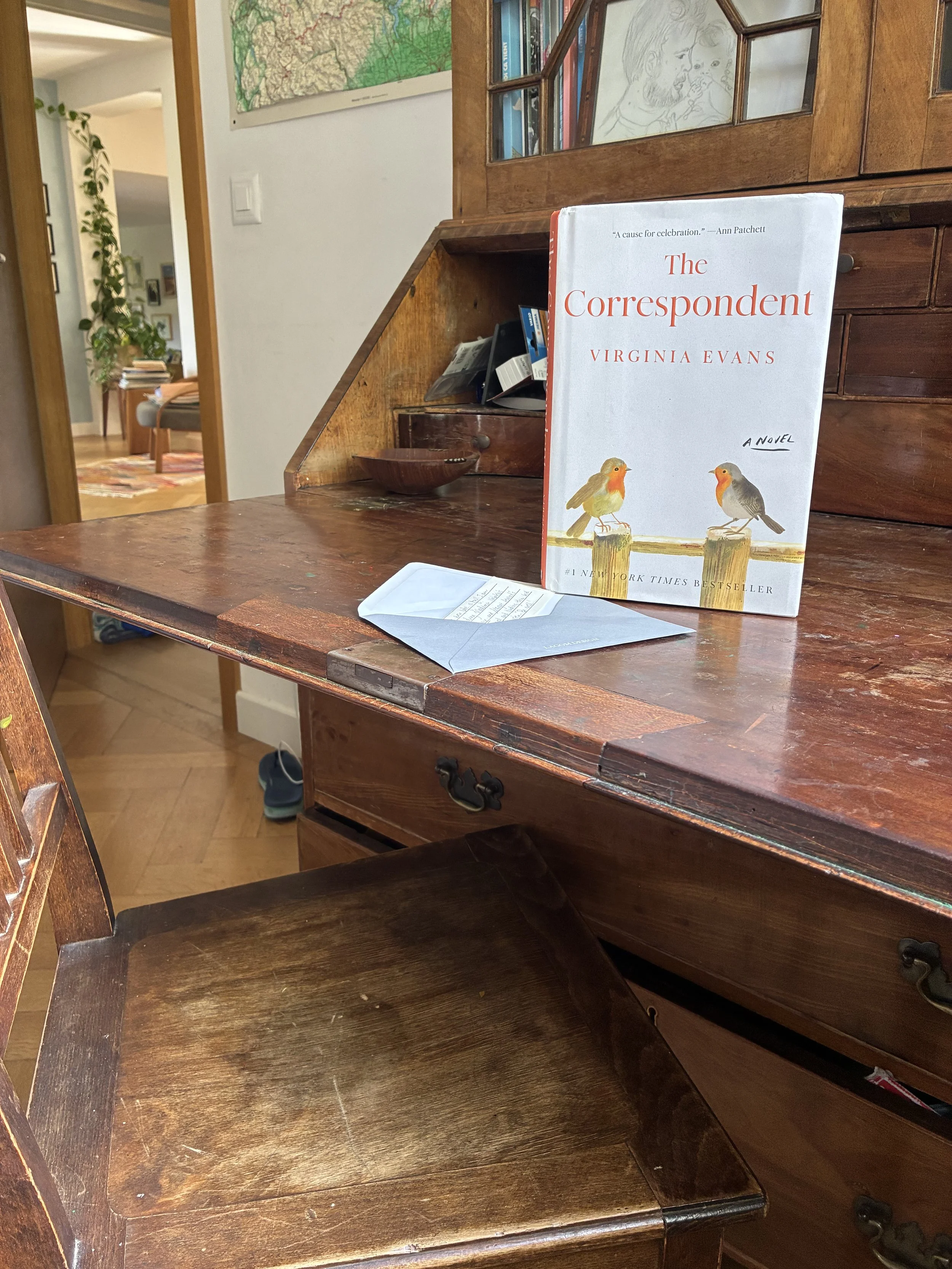
An entirely epistolary novel is not common in the world of contemporary literature. Indeed, the act of writing physical letters has all but evaporated in the digital space of the 21st century, and yet the acclaim Virginia Evans’s The Correspondent (2025) has received demonstrates just how keenly humans long for connection with others, even through the dying art of written correspondence. Sybil Van Antwerp is a strange duck; she insists on writing letters (and occasional emails) as she has since girlhood. Her correspondence includes regular letters to author Joan Didion, her childhood best friend turned sister-in-law, her brother, and many other characters including the new Dean of the English Department at her local university. Through her letters, Evans reveals a woman in her early 70s (the book opens in 2012) who has lived and loved and lost much. As a her correspondence continues, readers watch Sybil grow, even as she enters her golden years; it is beautiful and inspiring.
Evans’s protagonist is complex. A retired attorney, Sybil was a female trailblazer in a career-field dominated by men. Yet, she used her work to hide from her life at times, and now as she ages, she must reckon with the consequences. The Correspondent covers myriad themes while providing readers with a cross-section of an aging woman’s life. Sybil’s letters touch on love, death, aging, parenting adult children, retirement, divorce, women trailblazers, the death of a child, grief, Alzheimer’s, and of course, letter writing.
In addition to being a great lover of writing letters, Sybil is also an avid reader. She often writes to the authors of books she enjoys; and they often respond to her with letters of their own. What’s more, she and her childhood best friend turned sister-in-law always close their letters (as they have since teen years) with a short line about their current read and inquiry into the other’s. This bit, along with so many other wonderfully touching and real-feeling parts, make The Correspondent such a joy. Despite all the hurt and loss Sybil has experienced in her life, she perseveres boldly. Through letter writing she finds peace and even healing; written words are easier to mold and Sybil, like many of us, prefers communicating through correspondence.
This is a novel to read quickly. I read the entirety over the course of a long day of air travel. While the end seemed slightly rushed, I thoroughly enjoyed this debut. Evans has captured much of what it is to be human in contemporary times. Fans of Elizabeth Stroud will adore Sybil and the complicated world her correspondence reveals.
Bibliography:
Evans, Virginia. The Correspondent. Crown Publishing, 2025.
A Few Great Passages:
“There is an articulation of life one hears again and again. People will say, 'oh, this is only a season.' [. . . ] I take issue with this. There are, by definition, four seasons that repeat in measured pattern year after year. As there is no such rhythm in the human life, I have to think that when it comes to seasons we all get one round. We are born and grow through childhood in spring. We live those glorious, lively, interesting years of our twenties, thirties, forties in summer. We settle into ourselves in autumn, that cool but not yet cold time, rich and aromatic. And in winter we age (brutally) and die. One turn of the seasons per person, unless it's cut short” (27-28).
“Imagine, the letters one has sent out into the world, the letters received back in turn, are like the pieces of a magnificent puzzle, or, a better metaphor, if dated, the links of a long chain, and even if those links are never put back together, which they will certainly never be, even if they remain for the rest of time dispersed across the earth like the fragile blown seeds of a dying dandelion, isn't there something wonderful in that, to think that a story of one's life is preserved in some way, that this very letter may one day mean something, even if it is a very small thing, to someone?” (46).
“I write slowly. A letter might take me an hour or more. I do not rush. I think through each sentence. My hand does not get tired. You mustn't rush. When you rush you pen things you didn't mean and you tire. It takes patience to say exactly what one means, to think of the right word. Sometimes I write a draft and mark it up, then write a clean copy to send. I believe one ought to be precious with communication. Remember: words, especially those written, are immortal” (123).