
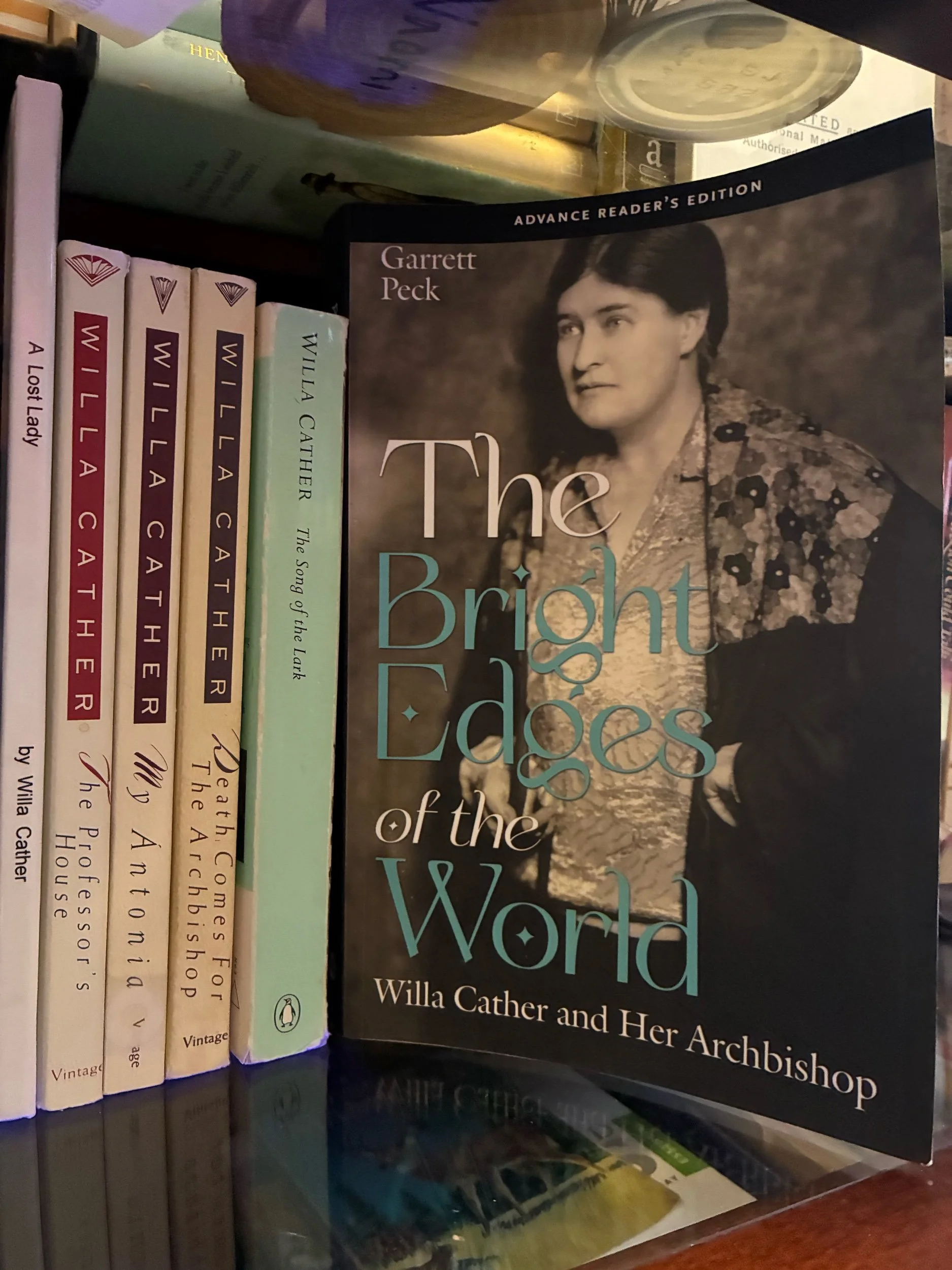
To The Bright Edges of the World: Willa Cather and her Archbishop
Garrett Peck offers a fascinating new biography of Willa Cather in The Bright Edges of the World: Willa Cather and Her Archbishop (expected 10 March 2026 from University of New Mexico Press). Thanks to the relatively recent publication of Cather’s letters and Peck’s personal knowledge of the US Southwest (from his vantage as tour guide in Santa Fe, New Mexico), To The Bright Edges of the World explores Willa Cather’s visits to the US Southwest through the 19teens and 20s, culminating with the publication of her final Southwest book: Death Comes for the Archbishop (1927).
Anyone who has read Death Comes for the Archbishop understands it is Cather’s beautiful ode to the US Southwest. She fictionalizes the historic Father Lamy and through his story as she celebrates the history, geography, and people of what would become southern Colorado, Arizona and most notably New Mexico. Simply Cather’s use of color in this birth-to-death saga is a testament to the ways Cather was struck by the light and majesty of the Southwest on her personal travel through the region.
Peck’s biography eloquently weaves together literary and historical references with a hefty dose of direct citation of letters, along with descriptions of Cather’s life. Peck’s biography introduces readers to the Cather’s early life and the foundations of her literary career: being transplanted from Virginia to Red Cloud, Nebraska at age 11, her university years and the seemingly romantic relationships with other women that punctuated her young adulthood, adult life in New York City with her life partner, Edith Lewis. To the Bright Edges of the World creates a dynamic portrait of a non-traditional woman (particularly for her time) who also happened to be literary a genius.
Despite having read (and loved!) a few of Cather’s novels—My Antonia, Song of the Lark, and Death Comes for the Archbishop— this biography presented me a long list of fascinating facts and further reading. And yes, as the subtitle promises, this is a book that centers on Cather’s Archbishop, the book she often regarded as her best. In the letters Peck cites, readers can appreciate the enthusiasm with which Cather viewed the setting and subject matter of Death Comes for the Archbishop. In responding to a friend’s praise of the novel shortly after its publication, Cather replied. “‘Your letter gives me a fine glow of satisfaction [. . .] In this book I tried to be as self-less as the good missionary, to make the country my existence as it was his. I suppose one could very properly use that country as a decor, a setting, for a story of human emotions. But it most appeals to me as a thing big enough and beautiful enough to drink up all personal entanglements—almost personality itself!’” (126). Readers who know Archbishop recognize the joyful reverence with which Cather infuses her setting. Beyond Cather’s personal approach to writing Death Comes to the Archbishop, Peck’s book explores the historical characters that inspire Cather’s novel, her understanding of indigenous faith, and the Mexican priests who preceded Father (later Archbishop) Lamy. In other words, Peck’s new book is a treasure trove of information, perfect for scholars or enthusiasts alike.
Bibliography:
Peck, Garrett. The Bright Edges of the World: Willa Cather and Her Archbishop. University of New Mexico Press, 2026.