The Marriage Portrait

Maggie O’Farrell has done it again. She has rendered up a heroine of flesh and blood, whim and heartache, from the annals of European history. O’Farrell’s The Marriage Portrait (2022) fictionalizes the brief life of Lucrezia de’ Medici who married the Duke of Ferrara (Modeno, and Reggio as well) at age fifteen. As with O’Farrell’s last novel, Hamnet—also historical fiction—The Marriage Plot introduces readers to a vivacious young woman, bound in and restrained by her time, her class, and what everyone deems her destiny. This is novel rich in storytelling and moving prose. It is a masterpiece; one that transports readers to the regal rooms of sixteenth-century Florence and Ferrara.

The Wordhord

Hana Videen’s The Wordhord: Daily Life in Old English (2022) is a book exuding etymology and interesting factoids about what life was like during the days when Brits spoke Old English. This is a book about words, their usage, and definitions. The Wordhord is approachable and readable for a work of nonfiction that tackles a subject like Old English; Videen is clever and humorous as she unravels the onion of Old English for contemporary readers. While The Wordhord is certainly well-researched and academic, it does not lull its reader off to sleep as many books about medieval language and history might do. On the contrary, I found The Wordhord a compelling and entertaining read, one abounding with Old English words and tidbits I hope to remember long after reading.

Babel: An Arcane History

R. F. Kuang’s Babel: An Arcane History (2022) is a fantasy-inspired, alternate history of 1820 and 30s Britain and its relationship with the world beyond. As one might expect from the time period, Babel centers on themes of empire and colonialism. Oxford is the hub in Babel and not just for the academic study ongoing there. In the fantasy-like world building of Babel, Oxford houses the Tower, the center of colonial Britain’s translators’ world. In Kuang’s clever and moving novel, language and translation claim a power that creeps towards magic and provides the writer an eloquent metaphor through which to deconstruct the colonial project.

To The Lighthouse

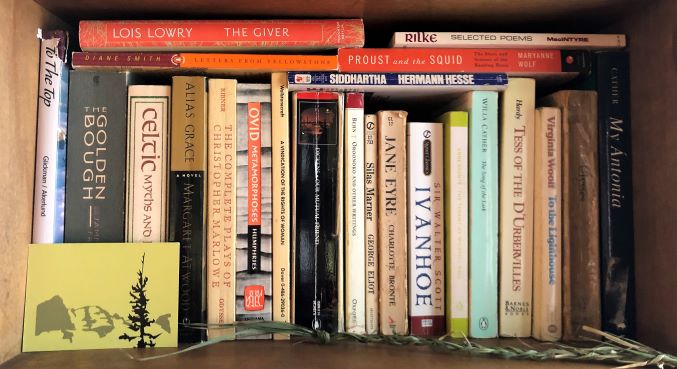
Virginia Woolf is a household name when it comes to lyrically figurative writing, rambling through the interior lives of characters. Her brand of modernism pairs the poetic with the complex; she champions an intellectualism that many other modernists (as well as readers and critics that have come since) have branded snobbish and off-putting. And yet, Woolf’s writing, like that of other modernists (James Joyce, for example), attempts to capture the inner life of humanity. Her fiction and nonfiction alike, excavate the uniqueness that is human thought, love, experience. In her novel To The Lighthouse (originally published in 1927 and one of my favorites among her oeuvre) Woolf again takes up this project. In this version, her investigation is Beauty (yes, with a capital “B”), the artistic process, and the muse.

Treacle Walker

I have read through Alan Garner’s Treacle Walker (2021) three times this fall. After reading a good chunk of it the first time through, I discovered that the slight novel (152 pages) begs to be read out loud. The rhythm of the language and the short sections (separated by untitled Roman numerals, eighteen in total) build in a genre-bending enchantment. Narrative becomes glamour becomes something beyond the stars: timeless.

The Coddling of the American Mind

Greg Lukianoff and Jonathan Haidt’s The Coddling of the American Mind: How Good Intentions and Bad Ideas are Setting Up a Generation for Failure (2018) came out five years ago and yet its message seems even more relevant today. Published before pandemic fueled parents and youth to even greater levels of anxiety and fear, The Coddling scrutinizes the generational shift on the part of society, schools, and parents that matches the advent of smart phone technology and the rise of social media. Those cultural transformations, the authors argue, led to a generation that equates physical safety with freedom from differing opinions and world views. Their thesis, that American families, universities, and society generally have lost sight of three fundamental truths when it comes to youth; in so doing we have fostered a climate of fragility and safetyism that undermines human resilience and encourages anxiety, us-vs-them culture, and rebrands discomfort and disagreement as unsafe. If their book was a must-read pre-pandemic, it is utterly imperative today.

And Yet: Poems

It is precisely these sorts of modern mothering moments, among other aspects of 21st-century womanhood, that inspire the poetry of Kate Baer. And Yet: Poems (2022) is her second full-length book of poetry, and it goes on sale on November 8. As with her first collection, What Kind of Woman (2020), which became and instant number one New York Times bestseller, And Yet scrutinizes what it is to be a white, American, middle class woman at this moment. Middle age, parenting, marriage, self-image, sex, health: all of these have their moments under the bright lights that are Baer’s poems.

When Women Were Birds

When Women Were Birds: Fifty-Four Variations on Voice (2012) by Terry Tempest Williams is both moving and masterful in its craft. This just-over-two-hundred-page memoir is a small book that fits easily in a purse or a large pocket. It is one designed to be taken along when you leave the house. When Women Were Birds weaves Williams’s personal and family histories with that of the land on which she came of age. As any fan of Williams will expect, this slender volume includes many a powerful metaphor, startling anecdote, and compelling social-justice perspective.

The Lowering Days

Gregory Brown’s debut novel The Lowering Days (2021) weaves together several families' stories who make their home along the Penobscot River just as the river collects many tributaries before it dumps into the sea. Two families, both alike in dignity, make their homes in the rural woods along the Penobscot near its mouth. One, the Creels, with Lyman and Grace at its head rely on the bounty of the sea. Lyman is a decorated war vet and a lobster man. Grace, like her name, walks a gracious path through marriage and maternity even in the face of unspeakable tragedy. The other, the Ames, is the result of a love union between boat-builder and activist journalist, Arnoux and Falon respectively. These neighbors have a deep and tenuous history, like the main branches of a river where it flows into the sea; The Lowering Days follows these many streams upriver to their sources.

How To Fly (In Ten Thousand Easy Lessons) Review

Barbara Kingsolver’s How to Fly (In Ten Thousand Easy Lessons) (2020) is her first collection of poetry. Kingsolver is, of course, beloved for her fiction, respected for her nonfiction, and now we might add, applauded for her verse. It is a collection I encourage any lover of poetry, particularly poetry by women, to reach for; it is a collection that will sit beside Mary Oliver’s Devotions on my shelf, its pages gradually more and more worn.

Gilead

Certain novels are slow and contemplative; they paint a portrait of a life or a time using carefully selected shades and hues to capture a mood. There may not be much action beyond that of memory, but it is enough. More than enough even. Marilynne Robinson’s winner of the Pulitzer and National Book Critics Circle Award, Gilead (2004) is one such novel. Contemplative, slow-burn writing like hers gets at the big questions of life with a hefty serving of earnest feeling sprinkled throughout. Written in first-person, Gilead is one man’s reflection upon his life, his family, and the meaning of human goodness.

A Gentleman In Moscow

These majestic surroundings and my freedom to enjoy them are not lost on me as I pull myself out of the story Amor Towles weaves in A Gentleman in Moscow (2016). Towles is a household name and over the course of the past eleven years (since the publication on Rules of Civility in 2011) he has acquired a well-deserved following. This, however, is my first Towles’ novel. I scan the mountains around me as moment by moment they glow deeper purple red a the sun sinks further toward the far western horizon before I return to the Count and the world of Moscow’s grand Metropol hotel; the contrast between his life and my own in this moment could not be more pronounced.

Throne of Glass Series

As anyone familiar with her other works would expect, Sarah J Maas’s Throne of Glass series includes a hefty dose of struggles (both internal and external) among a growing cast of characters who all come together in the hope of making a better world through love and friendship.

The Sorrow Stone

Kári Gískason’s The Sorrow Stone (2022) is a beautifully crafted historical fiction set in the 10th century. This novel adds to the growing body of historical fiction that builds on the stories of Nordic culture and the settlement of Iceland. Reading The Sorrow Stone transports the reader back through the centuries to a time of cold and hardship when revenge and duty weighed upon everyone, and when one woman is forced to face her past to save her son’s future.

Bewilderment

In Bewilderment, however, Richard Powers doesn’t limit the reader to life on planet earth; rather, through the first-person voice of his protagonist, astrobiologist Theo Byrne, Powers’ writing wanders the universe in search of life, but always returns home. Layering astronomy, biology, and neuroscience, this novel challenges its reader to think more broadly, to consider alternative truths, and to recognize how little we know about ourselves, our planet, and our universe.

Learwife

J. R. Thorp’s debut novel, Learwife (2021) is a lyrical, internal monologue of King Lear’s widow during some undefined point in British medieval history. The novel opens as news of Lear’s death, and that of his three daughters, reaches a convent in northern England. Here, amidst the stone walls and industrious lives of the nuns, resides the estranged wife of King Lear who slowly unravels her story while she grieves the family she had already lost. Thus, Thorp’s Learwife begins where Shakespeare’s tragic King Lear concludes and provides the missing queen’s perspective through her memories and her grief.