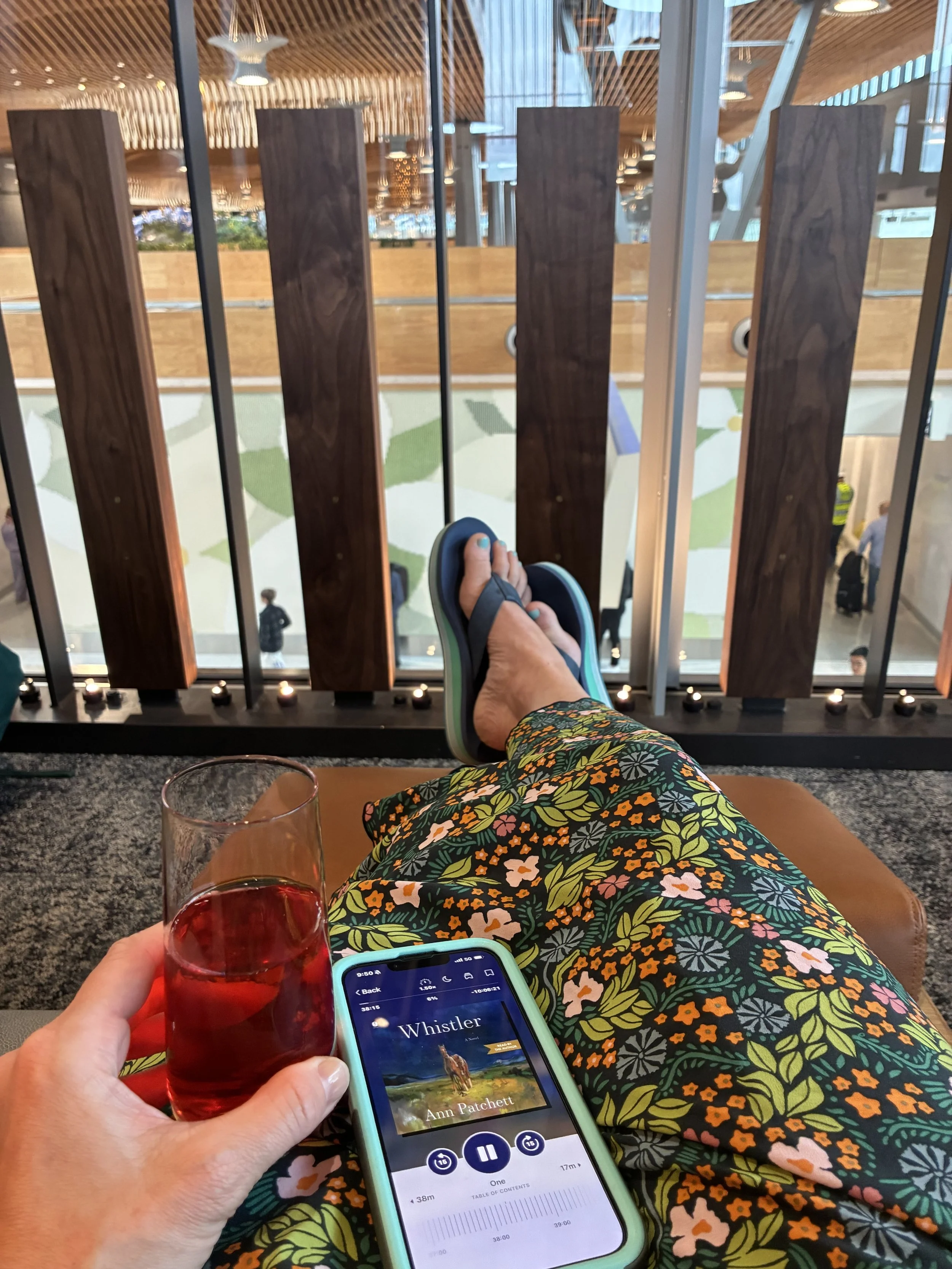
Whistler
Lives can pivot in the flash of a second. Paths cross to diverge to reconnect years ago. The people we truly love never really leave us. These are the premises behind Ann Patchett’s newest novel, Whistler (2026). Death, life, family, and love are the stuff of humanity; they are also fundamental themes in Patchett’s novel.
As with many of Patchett’s novels, Whistler, is the complex story of a family. Daphne and Leda are sisters whose lives changed drastically when as children the one had appendicitis and the other was in a terrible car accident with her stepfather, Eddie Triplett. Then, 44 years later, as adult women, they learn the complicated reality that their childhoods included (despite the fact that they were oblivious to it all).
At the center of this novel is the power of stories nested within stories. The stories we tell ourselves are sometimes corrected by new lived experience; the narrative shifts or our assumptions are revealed to be flawed. The true stories we hear can shape us, giving us hope just when we need it. They might even be the tales that canter back and forth through our lives: we hear them; we relate to them; we return to them (or they return to us). Indeed, stories can be talismans. That truth is the true magic of Whistler. It is a story about a story, a story that inspires and moves both the characters and the reader. Indeed, Patchett’s novel celebrates the power of storytelling.
I listened to this novel as an audiobook, giddy when a copy came available in the library app Libby. Ann Patchett herself beautifully narrates the audiobook. Then as the novel’s final pages were in hearing distance, my copy of the audiobook was returned (as I listened!). It was harsh, but I promptly went and purchased the book from my local bookseller. (I already knew it was one I would like to own.) When I opened to the final pages and found my place, I discovered that the print version has a horse silhouette on the chapters that recount events 44 years prior to the contemporary timeline. What a delightful discovery! I felt that my audiobook’s untimely return was actually a gift to me; as a result, I now own this beautiful novel (with a cantering horse on its covering), but I also appreciate a subtle layer in the book’s design. Without access to the physical book I would have missed that; without access to the audiobook, I would have missed out on Ann Patchett’s lovely narration. In either form Whistler is a novel that will move its reader and perhaps inspire them to appreciate the cherished relationships (and stories) we all have in our lives. I highly recommend any lover of domestic or literary fiction find a copy (audio or print).
As a footnote: of course, the fact that Daphne, Patchett’s protagonist, is a high school English teacher, only improves my adoration of this novel.
A second footnote: would that we all have a person like Eddie Triplett in our lives.
Bibliography:
Patchett, Ann. Whistler. Harper, 2026.
A Great Passage:
“[T]here's a tiny percentage of bad people in the world, and the bad people get all the publicity. Everybody's got to be vigilant against the bad people. [. . .] But there are so many more people who are going to want to help you. I mean so, so many more good people that you couldn't begin to count them. [. . .] I swear to you, it's mostly good people out there, with a few bad people around the edges” (268-69).