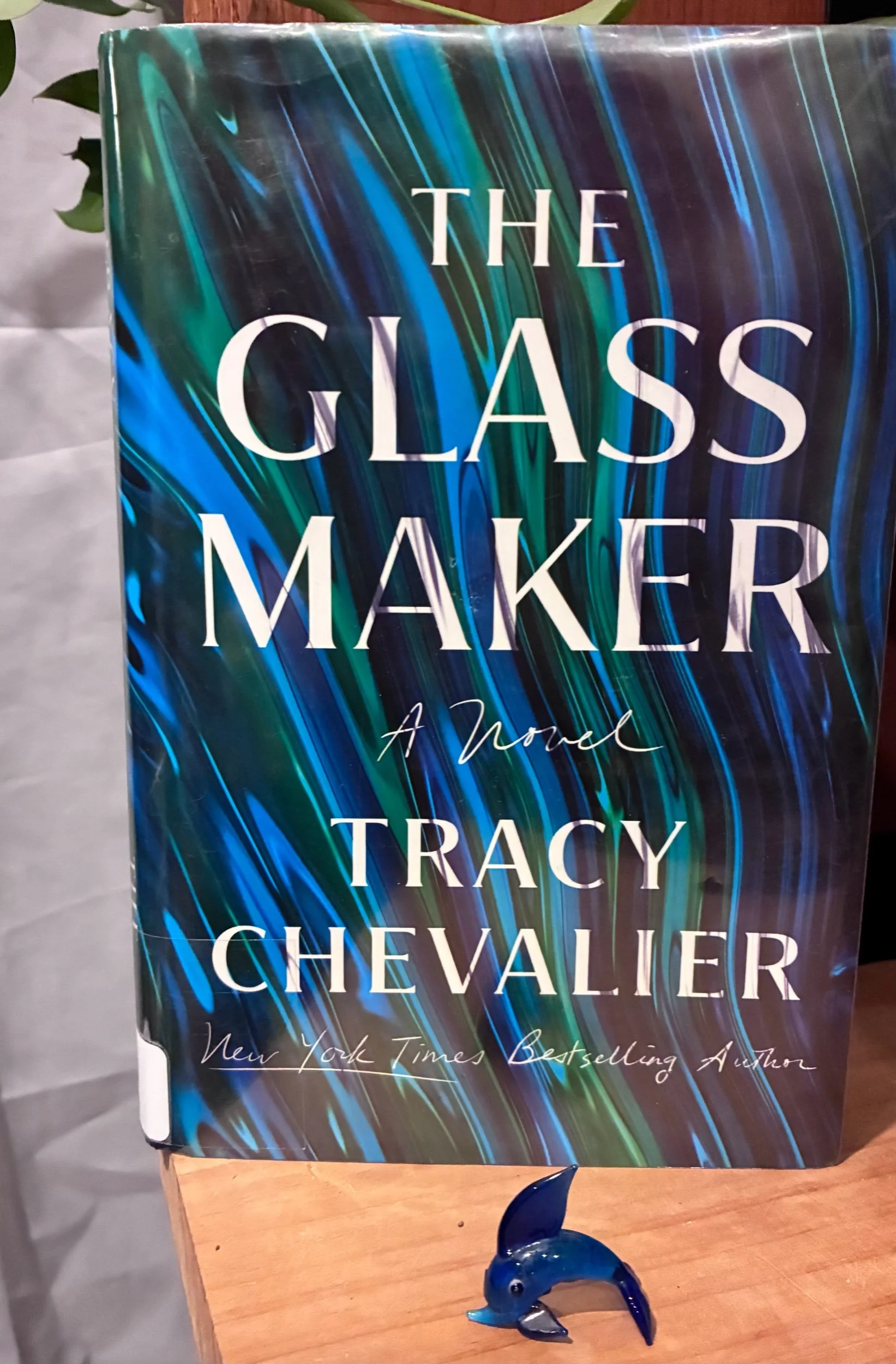
The Glassmaker
Tracy Chevalier’s The Glassmaker (2024) transports readers to the magical island of Murano, Italy. This historical fiction begins with “A Brief Explanation of Time” in which the narrator reflects: “it’s surprisingly hard to gauge the rate at which time passes—whether it moves faster for others than it does for you” (x). What follows is the story of glassmakers on Murano and their relationship with their neighbor city, Venice, in 1486. It ends post-COVID on the same island and with (some) of the same characters. Unlike other Chevalier historical fiction, The Glassmaker emerges from the “what if” scenario that people on Murano and Venice age more slowly than people on terrafirma; in what those of us on solid ground might experience as seventy years, they age four. Thus, The Glassmaker is both a moving family drama centered on one Muranese glassmaking family and a fascinatingly crafted story.
The Glassmaker herself is Orsola Rosso whom readers meet at age nine when she falls in a canal and is forced to enter a rival glassmaking family’s workshop to warm herself. Here she crosses paths with Maria Barovier, both a fictional character in Chevalier’s novel and a historic one. Orsola’s life, and that of her family, is never distant from glassmaking, but Chevalier’s novel encompasses far more. As a it slips like a stone over the lagoon (Chevalier’s simile, not mine), the narrative intertwines the history of Venice and Murano from the late fifteen century to near present day. As such characters like Napoleon (and bobble-loving Josephine) and Casanova grace its pages. Likewise, Chevalier’s plot weaves through plague, Napoleonic occupation, WWI and WWII, and the destruction each of these historic moments left in their wake. Chevalier portrays Venice as a cosmopolitan city at the heart of global trade in the fifteenth century. Enslaved Africans, as well as German merchants and Jews, populate the canals alongside Venetian and Muranese fishermen and glassmakers. As the years pass, Orsola ages and learns of loss. She also cultivates her creative spark and it remains constant through all the changes over (what those of us on terrafirma would consider) centuries.
After having lived for centuries, Orsola faces the modern world of climate change and COVID, confident that like all those other times when things felt hopeless, things will come ‘round. In her time, we readers witness Orsola come of age and learn to master lamp work glassmaking. We experience her great love and the resolution of a life of duty and creative drive. The novel’s conclusion is both satisfying and somewhat heartbreaking, as a great mystery is revealed to Orsola by an unexpected visitor.
This is a book to savor. Travel Renaissance Venice in a gondola and share naive Orsola’s trepidation by its bustle. Learn the craft of lamp work glassmaking, a traditionally female pursuit, as Orsola does in her youth. Witness the changes to geopolitics and trade as the fifteen century folds into the nineteenth then the twentieth. Chevalier is a masterful storyteller and folds brilliant research into her historical fictions. If any of these things sound appealing, I imagine you will very much enjoy The Glassmaker.
Bibliography:
Chevalier, Tracy. The Glassmaker. Viking, 2024.
A Few Great Passages:
“People who make things also have an ambiguous relationship with time. Painters, writers, wood-carvers, knitters, weavers, and, yes, glassmakers: creators often enter an absorbed state that psychologists call flow, in which hours pass without their noticing” (x).
“A pearl needs grit to be beautiful; beauty comes from the scar in the lip, the gap in the teeth, the crooked eyebrow” (385).